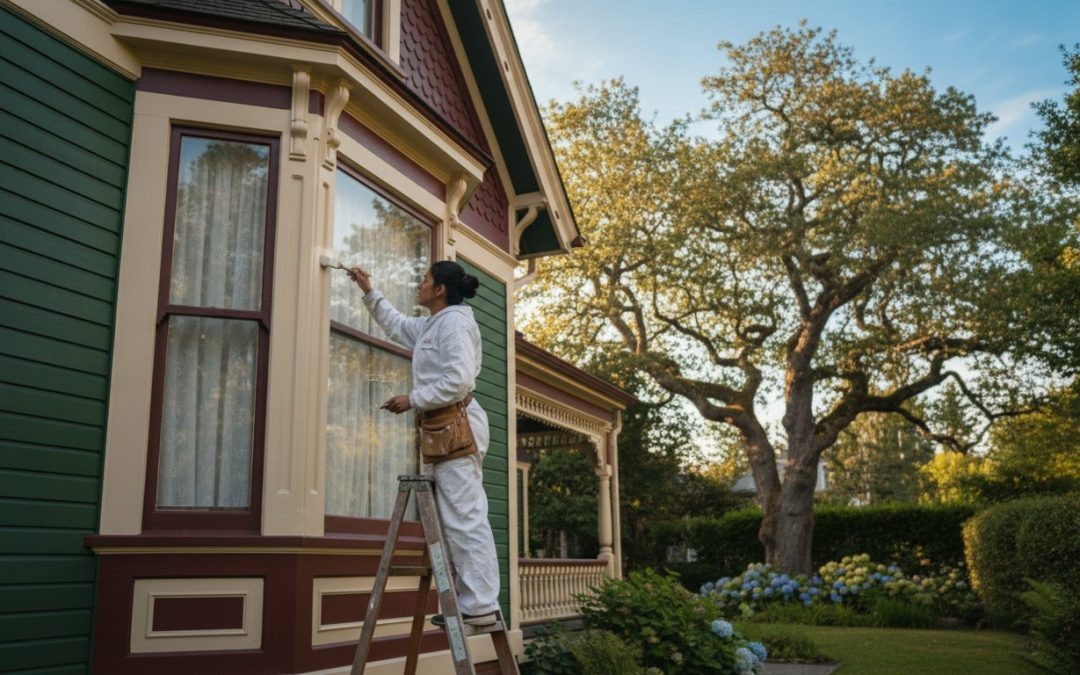
Is your heritage home merely a residence, or is it a vital piece of Victoria’s living history? Owning a classic property in the Capital Regional District is a unique privilege that comes with a significant responsibility to the past. Finding the right heritage home painters Victoria homeowners can rely on involves more than just selecting a colour; it requires a partner who understands the architectural language of the 19th and early 20th centuries. You want to preserve the intricate corbels and delicate gingerbread trim that define your home’s character, not bury them under thick, modern coatings.
It’s natural to feel concerned about the complexities of restoration, from the safety protocols required for lead-based paint to the pressure of choosing era-appropriate palettes that satisfy local heritage registries. We believe that professional painting is an act of stewardship that should offer both aesthetic excellence and lasting protection. This guide provides the historical expertise you need to navigate these challenges with confidence. You’ll discover how meticulous preparation and specialized materials can shield your property against Victoria’s salt air while significantly increasing its market value. We’ll walk you through the essential steps of a successful restoration, ensuring your home remains a masterpiece for generations to come.
Key Takeaways
- Learn why heritage restoration is a specialized discipline essential for preserving the unique architectural character of historic neighbourhoods like Rockland and James Bay.
- Understand the technical protocols required to safely manage lead-based paint and protect delicate wood siding from Victoria’s persistent coastal humidity.
- Discover how to select authentic “True Colours” palettes and work with heritage home painters Victoria experts to highlight your property’s original architectural details.
- Gain insight into the meticulous cleaning and preparation techniques that protect fragile old-growth cedar without the damage caused by aggressive power washing.
- Explore how specialized craftsmanship serves as a strategic investment in your property’s longevity and market value while honouring its historical significance.
The Architectural Legacy of Victoria: Why Heritage Painting is Preservation
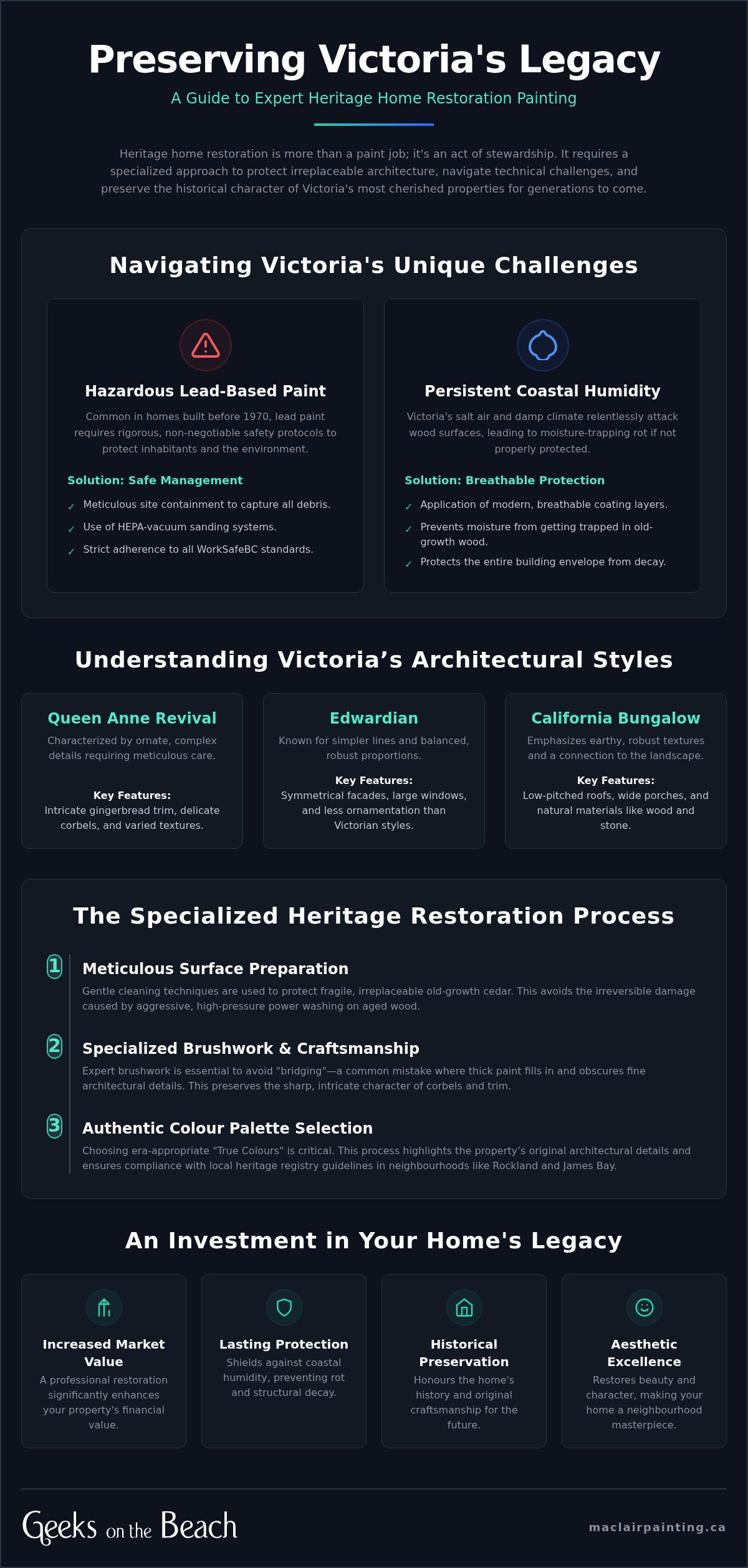
Victoria is a city defined by its past, where the streets serve as a gallery for some of Canada’s most well-preserved colonial and post-colonial structures. The architectural legacy of Victoria is most visible in storied neighbourhoods like Rockland, Fairfield, and James Bay, where century-old residences tell the story of early British Columbia. In these districts, heritage restoration painting is a specialized discipline that differs fundamentally from standard residential work. It’s not merely an aesthetic choice; it’s the scientific application of protective coatings designed to preserve old-growth timber that’s no longer replaceable. Professional heritage home painters Victoria residents trust understand that these surfaces require breathable layers and meticulous preparation to prevent the moisture-trapping rot that can destroy a historic building envelope.
A Heritage Designation is a formal municipal protection that identifies a property as having significant historical value, which requires owners to follow specific guidelines when altering or maintaining the exterior facade. This legal framework ensures that the city’s character remains intact, but it also means homeowners must be more deliberate in their maintenance choices.
Understanding Victoria’s Historic House Styles
Victoria’s residential landscape is remarkably diverse, featuring a range of styles that each demand a unique technical approach. You’ll find the ornate complexity of Queen Anne Revival homes, the balanced proportions of Edwardian structures, and the earthy, robust textures of California Bungalows. Each style presents specific challenges for a restoration team. For instance, the intricate gingerbread trim and delicate corbels found on Queen Anne properties require specialized brushwork to avoid bridging, which is a common mistake where thick paint fills in and obscures fine details. Maintaining the original grain and texture of the wood during the stripping and sanding phases is essential. If a contractor is too aggressive, they risk losing the subtle character of the old-growth cedar siding that has defined the property for over a century.
The Stewardship Mindset: Investing in Longevity
Owning a heritage property is an act of stewardship that requires a long-term perspective on maintenance. These homes often need a higher frequency of inspection to catch minor weathering before it becomes a structural failure, yet a correctly executed restoration by expert heritage home painters Victoria professionals ensures you won’t need a full repaint nearly as often. This process bridges the gap between aesthetic beauty and the long-term protection of the building envelope. Beyond the clear benefit of increased property value, there’s a profound psychological satisfaction in knowing you’re preserving a piece of local history. It’s an investment in quality and craftsmanship that honours the original builders while securing the home’s future for the next generation of Victorians.
Navigating Technical Challenges: Lead Paint and Coastal Humidity
Restoring a historic facade in the Capital Regional District requires more than a steady hand and an eye for colour. It demands a deep understanding of the chemical and environmental challenges unique to older structures. The most significant technical hurdle for any restoration involves the management of legacy materials. Lead-based paint was the industry standard for decades, and its presence in homes built before 1970 requires a rigorous, non-negotiable safety protocol. Professional heritage home painters Victoria residents trust must prioritize these safety measures to protect both the inhabitants and the local environment from hazardous dust and debris.
Lead-Safe Work Practices and Environmental Protection
Safe lead management is a cornerstone of responsible restoration. We employ a meticulous process of containment and HEPA-vacuum sanding to ensure that every particle of old coating is captured and disposed of correctly. Adhering to WorkSafeBC standards isn’t just a legal requirement; it’s a commitment to the health of the community. DIY lead removal poses a severe risk to historic property owners, as improper sanding or scraping can release toxic particulates that linger in the soil and air for years. A professional approach ensures your home remains a safe sanctuary while its original beauty is uncovered and preserved.
Combating the Coastal BC Climate
Victoria’s microclimate creates a unique set of stressors for old-growth cedar and fir siding. While the city sits in a rain-shadow, the proximity to the Salish Sea ensures constant humidity and salt-laden air that can rapidly degrade inferior coatings. Before a single drop of paint is applied, moisture testing is essential. Applying new layers over damp wood is a recipe for premature peeling and rot. Old wood is a living material; it breathes and moves as the seasons shift from damp winters to dry, breezy summers.
Selecting a waterproof exterior house paint that remains vapour-permeable is vital. These breathable coatings allow internal moisture to escape without compromising the protective outer shell. South-facing facades in neighbourhoods like Fairfield also endure intense UV exposure, which requires high-quality pigments to prevent fading. By balancing modern coating technology with traditional craftsmanship, heritage home painters Victoria experts ensure your property can withstand the elements. If you’re ready to shield your home against the coastal climate, you can explore specialized protection options at maclairpainting.ca.
Authentic Colour Palettes: Honouring Victoria’s Historic Neighbourhoods
Selecting the right palette for a historic property is a delicate balancing act between personal expression and civic responsibility. In Victoria, this process is often guided by the “True Colours” program, a collection of historically accurate shades based on the original pigments used in British Columbia during the late 19th and early 20th centuries. Expert heritage home painters Victoria homeowners consult understand that these colours aren’t just decorative; they are designed to harmonize with the city’s unique natural light and coastal landscape. While modern trends often lean toward minimalist greys, heritage restoration celebrates a richer, more nuanced spectrum that defines the character of our streets.
Finding a balance between historical accuracy and modern preference is the key to a successful project. You don’t have to sacrifice your personal style to honour the past. Instead, we use history as a foundation to create a look that feels both timeless and refreshed. Consider these five classic Victoria colour combinations that have stood the test of time:
- Harris Cream and Edwardian Red: A warm, inviting pairing often seen on Queen Anne Revival homes.
- Oxford Ivory and Victoria Sage: A soft, natural combination that highlights the organic textures of Edwardian architecture.
- Mount Royal Blue and Strathcona Grey: A stately, sophisticated duo perfect for larger manor-style properties.
- Pendrell Verdigris and Vancouver Copper: An earthy, distinctive choice that echoes the oxidized metals of the era.
- Mellish Yellow and Comox Green: A vibrant, cheerful palette typical of the early 20th-century California Bungalows.
The Role of Heritage Registries and Local Bylaws
Navigating the municipal approval process is a critical step for many property owners in the City of Victoria. It’s essential to distinguish between “Heritage Registered” properties, which are identified for their value but have fewer restrictions, and “Heritage Designated” homes, which are legally protected by local bylaws. For designated properties, any change to the exterior colour usually requires a permit from the municipal heritage committee. Professional painters play a vital role here, assisting owners by providing accurate physical samples and historical justifications that streamline the approval process.
Visual Balance: Body, Trim, and Accent Colours
A sophisticated heritage exterior typically follows the “Three-Colour Rule” to create depth and dimension. The body colour provides the foundation, while a lighter or darker trim colour defines the structure’s silhouette. Finally, accent colours are applied to the “jewellery” of the home, such as the gables, corbels, and window sashes. Historically, window sashes were often painted in very dark tones like deep forest green or black; this was a deliberate technique to make the frames disappear into the glass, creating a seamless look. For properties featuring original cedar shingle accents, utilizing premium wood staining services Victoria specialists offer ensures these natural elements are protected while maintaining their authentic charm. This layered approach ensures that every architectural detail is celebrated rather than lost.
Meticulous Preparation: The MACLAIR Process for Historic Surfaces
Preparation is the silent hallmark of a true restoration. While modern construction often relies on speed, heritage restoration demands a more patient, methodical approach to surface care. Heritage home painters Victoria specialists recognize that decades of atmospheric soot, sea salt, and pollutants have settled into the pores of your home’s siding. Removing this buildup is the first essential step. Power washing, while tempting for its speed, is often too aggressive for fragile heritage wood. It can inject water deep into the grain or cause the wood fibres to “fuzz,” leading to poor paint adhesion and potential rot. We favour gentle, hand-delivered cleaning methods that respect the integrity of the substrate.
Once the surface is clean, the focus shifts to mechanical preparation. Hand-scraping and feather-sanding allow us to preserve the wood’s original profile without the gouging often caused by power tools. This artisanal approach is particularly vital for old-growth cedar, which is prized for its tight grain and natural longevity. Because this wood is rich in tannins, we apply high-performance, oil-based primers specifically formulated to lock those tannins in. This prevents the unsightly brown staining that can bleed through modern water-based topcoats, ensuring your new finish remains pristine for years.
Restoring the Substrate: Beyond the Surface
True restoration requires looking beneath the old paint. We frequently identify “alligatoring,” where old oil-based layers have cracked into a pattern resembling reptile skin, or “peaking,” where the paint has pulled away from the wood. These issues cannot simply be painted over. We use a combination of specialized wood fillers and high-strength epoxy resins to rebuild original architectural details that have suffered from minor decay. This allows us to save historic trim rather than replacing it with modern, inferior materials. To finish the preparation, every joint and seam is carefully caulked with high-flexibility sealants that allow the house to expand and contract with Victoria’s seasonal shifts. You can request a professional consultation to evaluate the specific needs of your property’s substrate.
The Application Phase: Brush vs. Spray
The method of application is just as critical as the paint itself. Hand-brushing remains the gold standard for heritage homes. The physical action of the brush works the coating into the grain and ensures every crevice of intricate gingerbread trim is fully saturated. While we sometimes use modern spray equipment for large, flat areas to improve efficiency, we always follow with “back-brushing.” This technique uses a brush to manually work the sprayed paint into the surface while it’s still wet. This meticulous process achieves the “Master Class” finish that distinguishes elite residential painters Victoria BC residents trust for their most valuable assets. The result is a deep, uniform finish that looks as though it was crafted a century ago but offers the durability of modern science.
Investing in Your Legacy: Choosing a Specialized Heritage Partner
Choosing a partner to restore a historic facade is a decision that extends far beyond a simple transaction. It is an act of stewardship that directly impacts your property’s market value and the cultural pride of your neighbourhood. When you hire heritage home painters Victoria specialists, you’re commissioning a transformation that requires both technical precision and a deep respect for the original architect’s vision. A high-quality restoration acts as a shield, preserving the building’s envelope for decades while ensuring the home remains a highlight of the local streetscape.
Evaluating Portfolios and Local References
Price should never be the sole metric for selecting a restoration team. Instead, ask to see project portfolios that include work completed at least five years ago. This timeframe is the true test of a painter’s skill, as it reveals how their coatings have withstood the test of time and Victoria’s persistent humidity. A local company understands the subtle micro-climates of Vancouver Island, from the salt spray of Oak Bay to the damp, shaded avenues of Rockland. Verify that your chosen partner carries specialized liability insurance and has undergone specific training for heritage materials, ensuring your investment is fully protected.
Transparency is the foundation of a successful restoration. In our coastal climate, weather delays are a reality that must be managed with clear, proactive communication. We prioritize a methodical pace over a rushed schedule, as rushing through preparation or applying coatings during high humidity is the primary cause of early failure. MACLAIR Painting positions itself as a trusted consultant, guiding you through the complexities of the process so you feel supported from the first consultation to the final brushstroke.
Next Steps: Your Heritage Consultation
The journey begins with a comprehensive site walkthrough alongside a master painter. During this assessment, we evaluate the substrate’s condition, identify potential structural concerns, and discuss colour strategies that honour the home’s era. A detailed proposal follows, providing a clear roadmap that protects you from the “surprise” costs often associated with older homes. By articulating every technical requirement and material choice, we ensure the process is as refined as the final result. If you’re ready to preserve your property’s future, you can consult with the heritage experts at MACLAIR Painting to begin your restoration journey.
Securing the Future of Your Historic Home
Your heritage property is a testament to Victoria’s enduring character, and its preservation requires a commitment to excellence that goes far beyond the surface. We’ve explored how specialized techniques, from lead-safe remediation to the use of vapour-permeable coatings, are essential for shielding old-growth timber from our coastal humidity. By choosing heritage home painters Victoria experts who specialize in historic neighbourhoods like James Bay and Fairfield, you ensure that every architectural detail is protected for another century. Our team brings quiet confidence and master-class finishes to every project, prioritizing the meticulous preparation that luxury residences deserve.
We understand the responsibility of maintaining your home’s legacy and offer the technical expertise needed to navigate both municipal registries and environmental challenges. It’s time to invest in the longevity and aesthetic brilliance of your property. Request a Heritage Restoration Consultation with MACLAIR Painting and discover how our expertise in old-growth wood preservation can transform your historic environment. We look forward to helping you honour the past while securing a beautiful future for your home.
Frequently Asked Questions
Do I need a permit to paint my heritage-designated home in Victoria?
Yes, if your property is “Heritage Designated” by the City of Victoria, you generally require a Heritage Alteration Permit for any changes to the exterior colour. Registered properties have more flexibility, but it’s always wise to verify with municipal planners. Professional heritage home painters Victoria specialists can assist you by providing the physical colour samples and historical context required for the committee’s review, ensuring your project meets all local preservation standards.
How much more does heritage home painting cost compared to a standard repaint?
Heritage restoration involves a higher level of investment than standard repainting due to the intensive preparation and safety protocols required. The process often includes meticulous hand-scraping, lead-safe containment, and the application of premium, breathable primers. While the initial cost is higher, this thorough approach protects the structural integrity of your old-growth wood siding. It’s an investment in your property’s longevity that prevents the need for frequent, costly repairs in the future.
Can modern paints be used on 100-year-old wood siding?
Modern coatings can be used effectively on century-old wood, provided they are specifically formulated to be vapour-permeable. Old-growth cedar needs to “breathe” to release internal moisture; otherwise, the paint will bubble and peel. We utilize high-performance, modern acrylics that offer superior UV protection and flexibility while allowing the substrate to move naturally. This combination of traditional wood and modern science provides the best possible defence against Victoria’s coastal climate.
What are the “True Colours” for Victoria BC heritage homes?
The “True Colours” program is a historically accurate palette developed to reflect the original pigments used in British Columbia between 1880 and 1920. These colours were identified through microscopic analysis of original paint layers on historic buildings across the province. Using these shades ensures your home remains architecturally authentic to its specific era. It’s a popular choice for homeowners in Rockland and Fairfield who want to honour the city’s unique historical aesthetic.
How do heritage painters handle lead paint safely?
Safe lead management involves strict containment and the use of specialized equipment like HEPA-filtered vacuum sanders to capture all dust at the source. Professional heritage home painters Victoria teams follow WorkSafeBC guidelines to ensure that hazardous particulates don’t contaminate your soil or air. This methodical process protects your family and the environment while allowing us to strip away decades of old, failing coatings to reach a sound, paintable surface for the new finish.
How long does a professional heritage restoration painting project typically take?
A comprehensive heritage restoration typically takes longer than a standard residential project, often spanning several weeks depending on the home’s size and condition. The timeline is primarily driven by the exhaustive preparation phase, which cannot be rushed if you desire a long-lasting finish. Weather also plays a significant role in Victoria; we only apply coatings during optimal humidity levels to ensure proper adhesion and a master-class finish that stands the test of time.
Is it better to stain or paint historic cedar shingles?
Choosing between stain and paint often depends on the original architectural style and the condition of your shingles. Breathable stains are excellent for preserving the natural texture of cedar while allowing moisture to escape easily, which is vital in our damp climate. However, many Victorian-era homes traditionally used solid paint to achieve a specific multi-colour aesthetic. We evaluate the wood’s health and your home’s historical context to recommend the most protective and authentic finish available.
Why is hand-brushing preferred over spraying for Victoria heritage homes?
Hand-brushing is preferred because the physical action of the brush forces the paint deep into the wood grain and intricate architectural carvings. This ensures a more robust bond and a thicker, more uniform protective layer than spraying alone can provide. While spraying is efficient for modern flat surfaces, it often skips over the subtle details of gingerbread trim. Hand-brushing respects the craftsmanship of the original builders and results in a more sophisticated, durable finish.