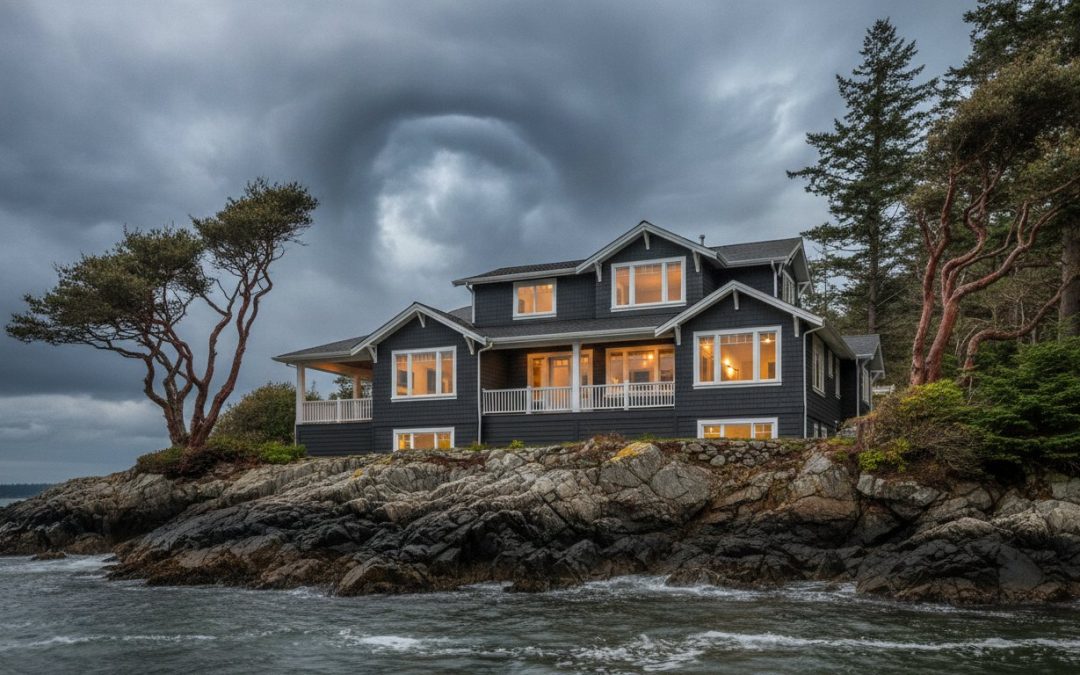
In the Pacific Northwest, your home’s exterior isn’t just a surface; it’s a front-line defence against one of the most aggressive climates in North America. Selecting the right durable exterior paint for BC is often the difference between a property that radiates curb appeal and one that succumbs to the relentless humidity. Most homeowners in Victoria and Vancouver are all too familiar with the sight of peeling paint after a single wet season or the stubborn green algae that thrives on shadowed, north-facing walls. It’s a common frustration to invest in your home’s appearance only to see the coastal dampness and intense summer UV take their toll within a few short years.
You deserve a finish that remains pristine for at least a decade, providing a maintenance-free sanctuary that stands up to salt air and heavy rainfall. This article uncovers the technical standards and specific coating features required to protect your investment. We’ll explore why 100% acrylic resin chemistry and region-specific mildewcides are essential for our unique environment. By the end, you’ll understand the science behind high-performance coatings and feel confident choosing a product that’s truly engineered for the Pacific Northwest.
Key Takeaways
- Understand how British Columbia’s unique humidity and moisture cycles impact paint adhesion to prevent premature peeling and structural failure.
- Learn why 100% acrylic latex is the technical gold standard for durable exterior paint for BC due to its superior flexibility and breathability.
- Discover the essential role of advanced mildewcides and UV inhibitors in preserving your home’s colour and preventing the common “green wall” phenomenon.
- Identify the most effective coating strategies for specific West Coast surfaces, from traditional cedar siding to specialized elastomeric options for stucco.
- Realize why meticulous professional preparation is the vital foundation for achieving a maintenance-free exterior that lasts for over a decade.
Why BC Weather is the Ultimate Test for Exterior Paint
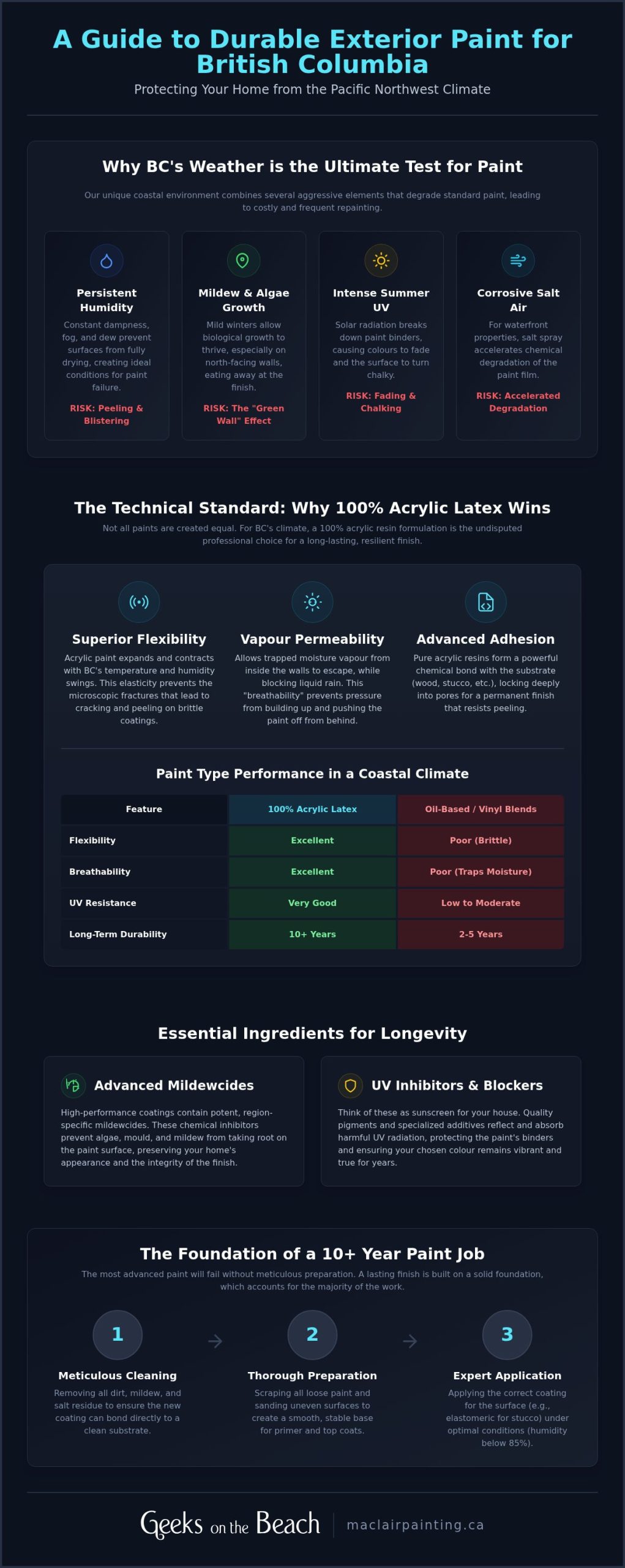
Living on the West Coast offers unparalleled beauty, but for a home’s exterior, it’s a relentless battle against the elements. Finding a truly durable exterior paint for BC means understanding the unique stressors of our coastal environment. Our climate is defined by a cycle of heavy fog and morning dew that creates a constant state of dampness, often preventing surfaces from ever fully drying out during the winter months.
This persistent moisture leads to the “Green Wall” phenomenon. In our mild winters, mildew and algae don’t go dormant; they thrive. Without the right chemical inhibitors, north-facing walls can quickly become colonized by biological growth that eats away at the finish. Conversely, south-facing surfaces in Victoria face intense summer UV exposure. This radiation breaks down the binders in lower-quality paints, leading to premature chalking and a dull, faded appearance that robs a home of its curb appeal. For waterfront properties in Oak Bay and Saanich, the added factor of corrosive salt air accelerates this degradation, demanding a coating with exceptional chemical resistance.
The Impact of Persistent Humidity on Coating Adhesion
Blistering and peeling are rarely just surface issues; they’re often the result of moisture trapped behind the paint film. When liquid water or vapour is caught between the substrate and the coating, it exerts pressure that eventually breaks the adhesive bond. Traditional oil-based paints were once the standard, but they often fail in damp BC environments because they form a brittle, non-porous shell. Modern 100% Acrylic Latex systems have become the professional choice because of their inherent breathability. These coatings allow microscopic amounts of water vapour to escape while remaining watertight against rain, ensuring the paint stays attached to the wood or masonry beneath.
Victoria’s Unique Microclimates and Painting Windows
Precision in painting requires a deep understanding of local geography. Victoria benefits from the rain shadow effect of the Olympic Mountains, resulting in less annual rainfall than Vancouver or the Westshore. However, this doesn’t mean the risks are lower. Local wind patterns can carry salt spray or environmental debris onto a freshly painted surface, potentially ruining a finish before it has time to cure. The window for optimal application in the Pacific Northwest is notoriously narrow. Professional results depend on monitoring relative humidity levels, which must remain below 85% to ensure proper film formation. Success isn’t just about the product; it’s about the technical expertise to recognize when the environment is ready to accept it.
The Technical Standard: Why 100% Acrylic Latex Wins
Achieving a resilient finish in the Pacific Northwest starts with the quality of the binder. While many products claim to offer protection, 100% acrylic latex remains the undisputed benchmark for durable exterior paint for BC. Unlike budget-friendly blends, these coatings utilize pure acrylic resins that act as a high-performance adhesive, bonding deeply into the pores of cedar, hardy plank, and masonry. This chemical bond is what prevents the premature peeling discussed in the previous section, ensuring the coating remains a permanent part of the substrate rather than a superficial layer.
Flexibility is perhaps the most critical technical attribute for West Coast homes. As our local environment shifts from saturated winter weeks to dry, sun-drenched summers, building materials naturally expand and contract. Brittle paint films can’t keep up with this movement, leading to microscopic fractures. Acrylic resins possess an inherent elasticity, allowing the paint to stretch and recover without losing its integrity. This “memory” ensures that the protective shell remains intact through every seasonal transition, providing a stable defence against the elements.
Vapour permeability, or “breathability,” is the final pillar of acrylic performance. While the coating must shed heavy rainfall, it must also allow internal moisture vapour to escape. If a coating is too restrictive, trapped humidity will force the paint off the surface from the inside out. High-quality acrylics are engineered with a molecular structure that blocks liquid water while remaining porous to vapour. If you’re looking to upgrade your property’s protection, consulting with professional exterior painters can help you identify which specific resin technology is best suited for your home’s exposure.
Acrylic vs. Vinyl and Oil-Based Alternatives
Vinyl-acrylic blends are often marketed as cost-effective alternatives, but they’re generally ill-suited for high-moisture zones. These “cheap” binders break down rapidly under UV stress and lack the moisture resistance of pure acrylics. Oil-based paints, once the standard for all exteriors, are now largely relegated to specific primer roles, such as blocking tannin bleed in new cedar siding. Modern low-VOC acrylics have surpassed oil in almost every performance metric, offering superior colour retention and a more environmentally responsible profile for our local residential neighbourhoods.
The Role of High-Build Coatings in Property Preservation
For homes with stucco or masonry, high-build coatings provide an essential layer of structural preservation. These specialized formulas are designed to be applied at a greater thickness than standard paints, which allows them to bridge hairline cracks and smooth out surface irregularities. A high-build acrylic coating acts as a formidable barrier against wind-driven rain, sealing the building envelope without sacrificing breathability. Integrating advanced Mildewcides and UV Blockers into these thicker films ensures that the protection remains effective against both biological growth and solar degradation for years to come.
Essential Ingredients for Longevity: Mildewcides and UV Blockers
Selecting a durable exterior paint for BC involves looking past the brand name and examining the specific additives that fight our local stressors. Professional-grade coatings distinguish themselves through a higher volume of solids. These solids are the pigments and resins that remain on the wall after the liquid carrier evaporates. A higher solids content provides a thicker, more opaque film that hides surface imperfections and offers a sturdier shield against the elements than budget-friendly, watered-down alternatives.
Homeowners often worry when they see mysterious brown, waxy streaks appearing on freshly painted siding after a light rain or a heavy morning fog. This phenomenon, known as surfactant leaching, occurs when water-soluble ingredients rise to the surface before the paint has fully cured. In our humid coastal climate, this is a common occurrence. While it’s typically harmless and eventually washes away, recognizing this process is part of understanding how modern, high-performance coatings stabilize in a damp environment.
Combatting Biological Growth in Shaded Areas
North-facing walls in Victoria and the surrounding areas rarely see the drying warmth of the sun, making them prime real estate for algae and mildew. To prevent the unsightly “Victoria Green” look, premium paints incorporate concentrated mildewcides that inhibit the growth of spores. The sheen of your paint also plays a role in this defence. Smoother, higher-sheen finishes provide fewer microscopic “anchors” for organic material to latch onto, making them naturally more resistant to growth than flat or matte alternatives that have a more porous texture.
Colour Retention and the Physics of UV Protection
While rain is the primary concern for most, the summer sun in Saanich can be equally destructive to your property’s aesthetic. UV inhibitors act as a high-grade sunscreen for your home, preventing solar radiation from breaking down the chemical bonds of the paint. The choice of pigment is vital for long-term satisfaction. Inorganic pigments, derived from minerals and earth, are far more stable than synthetic organic dyes. They resist fading and “chalking” much better, ensuring that deep, sophisticated colours remain vibrant rather than turning into a dusty, pale imitation of their original shade within a few seasons.
Selection Guide: Matching Paint to BC Surfaces
Identifying the correct substrate is the first step in ensuring the longevity of your property’s finish. While the chemical composition of the coating is vital, the physical surface of your home dictates how those resins interact with the local environment. Victoria’s diverse housing stock ranges from century-old heritage wood to modern fibre cement, and each requires a bespoke approach to remain resilient against the salt air of Oak Bay or the persistent dampness of the Westshore. Selecting a durable exterior paint for BC is not a one-size-fits-all process; it’s a technical matching of product to material.
The “Sheen Factor” is a critical component of this selection guide that homeowners often overlook. Choosing between flat, low-lustre, and soft gloss is a balance of aesthetics and utility. Flat finishes are excellent for hiding surface imperfections on older homes, but their porous nature can attract more dirt. In contrast, low-lustre or soft gloss options provide a smoother surface that sheds water and resists organic growth more effectively, which is essential for maintaining a clean aesthetic in the face of coastal dampness.
Preserving Coastal Woodwork and Siding
Cedar remains a hallmark of West Coast architecture, but its natural oils present a unique challenge for adhesion. To achieve a truly resilient finish, raw cedar must be treated with a high-quality tannin-blocking primer before any topcoat is applied. This prevents the natural resins from leaching through and discolouring the paint. For those who prefer to highlight the natural grain of the wood, our wood staining services Victoria offer a breathable alternative to solid paint. Semi-transparent stains behave differently than solid-body coatings; they penetrate the wood fibres to provide protection from within, rather than forming a surface film that could eventually peel.
Stucco, Masonry, and Modern Fibre Cement
Stucco exteriors often require specialized elastomeric coatings to manage the moisture challenges of our region. These products are significantly thicker than standard acrylics, providing the elastic bridge needed to seal hairline fractures that naturally occur in masonry. Conversely, modern fibre cement, such as James Hardie siding, is perhaps the most stable substrate for high-performance acrylics. Its engineered stability and lack of organic movement allow top-tier durable exterior paint for BC to reach its maximum lifespan without the risk of rot or tannin-related failure.
Strata and Commercial Considerations
Managing a multi-unit complex or a medical facility requires a focus on long-term lifecycle costs and property preservation. The durability requirements for these buildings are heightened by the need for a cohesive aesthetic across expansive surfaces. We often recommend durable paint for high-traffic strata hallways to ensure the transition from exterior to interior remains resistant to scuffs and moisture. A professional maintenance plan is an essential investment to preserve the property’s value and avoid the compounding costs of environmental neglect. If you are ready to protect your investment with a tailored coating strategy, contact our team today for a professional consultation.
The MACLAIR Approach: Ensuring Your Investment Lasts
Excellence in property maintenance isn’t found in a single product, but in a meticulous process. While we’ve explored the complex chemistry of durable exterior paint for BC, that chemistry only performs at its peak when applied to a perfectly prepared surface. At MACLAIR, we view every project as a long-term investment in asset preservation. Our philosophy moves beyond simple aesthetics; it’s about providing a transformative experience that safeguards your home’s value for years to come. We approach every surface with the mindset of a master craftsman, ensuring the finish is as functional as it is artistic.
A high-performance coating is only as strong as its bond to the substrate. Even the most advanced resins will fail if they’re applied over salt, dirt, or failing previous layers. This is why we position painting as an essential strategy for property longevity rather than a mere cosmetic update. By treating the building envelope as a whole, we ensure that your home remains protected against the relentless moisture cycles that define our region.
The Critical Role of Preparation in Coastal Painting
The foundation of longevity lies in professional surface preparation Victoria residents expect from high-end specialists. We don’t just mask imperfections. Our team follows a rigorous protocol of cleaning, scraping, and priming tailored to the specific material of the building. For waterfront estates in areas like Oak Bay, this often involves hand-scrubbing to remove salt deposits and oxidation that standard pressure washing might overlook. We also prioritize high-quality caulking to prevent water ingress, sealing the building envelope against the persistent coastal dampness that leads to structural decay.
Partnering with Victoria’s Trusted Painting Consultants
Precision application requires constant vigilance regarding the Pacific Northwest’s atmospheric conditions. We carefully monitor relative humidity and surface temperatures to ensure the environment is within the optimal window for proper film formation. This methodical pace reflects the precision of our services; we never rush a project at the expense of the final result. Whether we’re restoring a delicate heritage home or protecting a modern strata complex, the goal remains a finish that exudes quiet confidence and pride in craftsmanship.
Choosing a trusted consultant means your product selection is tailored to your specific neighbourhood’s microclimate. We take deep pride in our work and the long-term relationships we’ve established within the local community. Protect your property with MACLAIR Painting and ensure your home remains a standard of aesthetic excellence regardless of the weather.
Investing in Your Property’s Coastal Resilience
Protecting your home from the unique environmental pressures of the West Coast requires more than just a fresh coat of colour. It demands a technical understanding of 100% acrylic resins and the specific additives that resist our region’s persistent moisture and intense solar exposure. Achieving a maintenance-free exterior for the long term depends on matching high-performance coatings to your home’s specific substrate and prioritizing the meticulous surface preparation we have detailed. When you select a durable exterior paint for BC, you aren’t just performing a maintenance task; you’re making a strategic investment in asset preservation.
As specialists in Victoria strata and luxury residential properties, we bring a master craftsman approach to every project we undertake. Our deep expertise in high-durability coastal coatings ensures that your chosen product is scientifically suited for the Pacific Northwest’s relentless rain and salt air. We invite you to secure your property’s future with a professional consultation from MACLAIR Painting. You can move forward with the quiet confidence that your home’s aesthetic excellence is built to withstand the coastal elements for a decade or more.
Frequently Asked Questions
What is the most durable exterior paint for the BC coast?
100% acrylic latex is widely considered the most durable exterior paint for BC due to its superior flexibility and moisture resistance. Premium products are specifically engineered to withstand coastal humidity and utilize advanced resins that bond deeply to the substrate. This creates a resilient shield against the Pacific Northwest’s relentless rain. For stucco exteriors, specialized elastomeric coatings offer an even thicker protective layer that bridges hairline fractures and prevents water ingress.
How often should I repaint my house in Victoria, BC?
Most Victoria homes require repainting every seven to ten years, though this timeline varies based on your property’s exposure and the quality of the previous coating. Waterfront homes in Oak Bay or those with natural wood siding may need attention every five to seven years to prevent moisture damage. Regular maintenance, such as washing away salt deposits and touching up small areas of wear, can significantly extend the life of your investment.
Is acrylic or oil-based paint better for exterior wood in BC?
High-performance acrylic latex is far superior to oil-based paint for the vast majority of exterior wood surfaces in British Columbia. While oil-based primers remain essential for blocking tannins in raw cedar, an acrylic topcoat provides the necessary breathability and UV resistance that oil lacks. Oil-based finishes tend to become brittle over time, leading to cracking and peeling as the wood naturally expands and contracts with our seasonal humidity shifts.
Can you paint the exterior of a house when it is humid outside?
You should avoid painting when the relative humidity exceeds 85%, as high moisture levels interfere with the paint’s ability to form a proper film. If the air is too damp, the water in the paint cannot evaporate efficiently, which often leads to poor adhesion and a compromised finish. Professional painters use hygrometers to monitor local conditions, ensuring that every layer is applied during an optimal window to guarantee performance.
Why does paint peel so quickly on Vancouver Island homes?
Rapid peeling on Vancouver Island is usually caused by moisture trapped behind the paint film or inadequate surface preparation. Our coastal environment’s high humidity and frequent fog can saturate wood and masonry, forcing the coating off the surface from the inside out. Additionally, salt air deposits can interfere with the bond of new paint if the substrate isn’t meticulously cleaned. Using a durable exterior paint for BC and following rigorous preparation protocols are essential.
What is the best month to schedule exterior painting in Victoria?
The optimal window for exterior painting in Victoria typically spans from late June through early September. During these months, the region experiences its lowest rainfall and most consistent temperatures, providing the dry conditions necessary for coatings to cure properly. While Victoria’s rain shadow effect offers more flexibility than Vancouver, it’s still vital to avoid the unpredictable dampness of early spring and late autumn to ensure the longevity of your property’s finish.
Do darker exterior colours fade faster in BC summers?
Darker exterior colours do tend to fade more rapidly in BC summers because they absorb a higher percentage of UV radiation. This heat absorption can also place additional stress on the siding, leading to increased expansion and contraction. To mitigate this, we recommend choosing premium paints with inorganic pigments and advanced UV inhibitors. These sophisticated formulas are specifically designed to retain their depth and elegance even on sun-drenched, south-facing walls common in Saanich.
How does salt air affect the lifespan of my exterior paint?
Salt air acts as a corrosive agent that can accelerate the chemical breakdown of paint binders and damage underlying substrates. For waterfront properties, salt crystals can trap moisture against the surface, leading to blistering and premature coating failure. Regular cleaning is essential for these homes to remove abrasive deposits. Choosing a high-quality acrylic finish provides the necessary chemical resistance to withstand this harsh marine environment while maintaining the structural integrity of your home.