Why should the pursuit of safety in your commercial space mean compromising on the visual elegance of your property? Many property owners harbour a legitimate fear that adding traction means living with an industrial, sandpaper-like texture that’s nearly impossible to keep clean. You likely understand the weight of slip-and-fall liability, particularly when the relentless moisture of a Victoria winter settles on your floors. It’s a delicate balance to maintain, but you don’t have to choose between a hazardous surface and an unattractive one.
This guide demonstrates how advanced non-slip epoxy floor coatings transform dangerous environments into sophisticated, high-traction spaces without sacrificing aesthetic grace. You’ll discover how we utilize precision-engineered additives to meet rigorous safety standards, such as the P5 or R12 ratings required for demanding commercial settings. We will preview the meticulous application process that ensures your floors remain durable and easy to maintain, providing a transformative experience that preserves your property’s value while offering absolute peace of mind.
Key Takeaways
- Learn how the microscopic mechanics of friction work within non-slip epoxy floor coatings to provide superior traction without compromising the floor’s aesthetic elegance.
- Discover why professional surface preparation, specifically diamond grinding, is the essential foundation for a coating that remains durable and secure for years.
- Identify the specific traction profiles required to meet safety standards in high-traffic commercial and medical environments across Victoria.
- Debunk the common myth that textured surfaces are difficult to clean by understanding how the correct aggregate selection simplifies long-term maintenance.
- Understand how to customize the “grip profile” of your flooring to balance safety and style based on your property’s unique usage and environmental challenges.
What Are Non-Slip Epoxy Floor Coatings?
At its core, a non-slip epoxy floor coating is a sophisticated, multi-layered system designed to provide an uncompromising bond between safety and style. It isn’t merely a layer of paint. It’s a high-performance resin matrix engineered to house specialized aggregates that disrupt surface tension. Understanding Epoxy resin basics is essential to realize why these systems are so durable. We combine high-solids resins with anti-skid media like industrial-grade quartz or aluminum oxide to create a surface that is both resilient and secure.
While standard epoxy creates a beautiful, glass-like finish, that very smoothness becomes a liability when exposed to liquid. This “skating rink” effect is a primary concern for commercial managers and homeowners alike. When a smooth resin surface meets water or oil, friction disappears instantly. By integrating non-slip epoxy floor coatings, property owners can significantly reduce liability risks while ensuring the surface remains easy to sanitize. It’s a proactive approach to property maintenance that prioritizes the well-being of every person who walks through your doors.
The Evolution of Surface Safety
Early attempts at traction often involved broadcasting simple play sand into wet paint. These methods were crude and often resulted in a floor that felt like sandpaper and trapped every speck of dirt. Modern engineering has gifted us with precision-engineered polymer beads and micronized aggregates. These innovations allow the coating to maintain its aesthetic clarity and vibrant colour while providing a reliable grip. We can now achieve “barefoot-friendly” textures that are perfect for residential basements or pool decks, proving that safety doesn’t have to be abrasive or visually dull.
Why Victoria Properties Require Enhanced Traction
Victoria’s unique coastal environment presents specific challenges that standard flooring simply cannot meet. Our high humidity levels and frequent rainfall mean that indoor-outdoor transitions are often perpetually damp. On Vancouver Island, we also contend with “concrete sweating,” a phenomenon caused by capillary action where moisture is drawn up through the concrete slab. This creates a thin, invisible film of water on the surface. When temperature fluctuations occur, the physical performance of the coating must remain stable. Specialized non-slip epoxy floor coatings are specifically formulated to handle these moisture challenges, ensuring that your garage or commercial entryway remains secure even during our wettest winter months. Property owners researching concrete floor epoxy Victoria solutions will find that addressing moisture management from the outset is the key to a long-lasting, high-performance finish.
The Science of Traction: How Non-Slip Additives Work
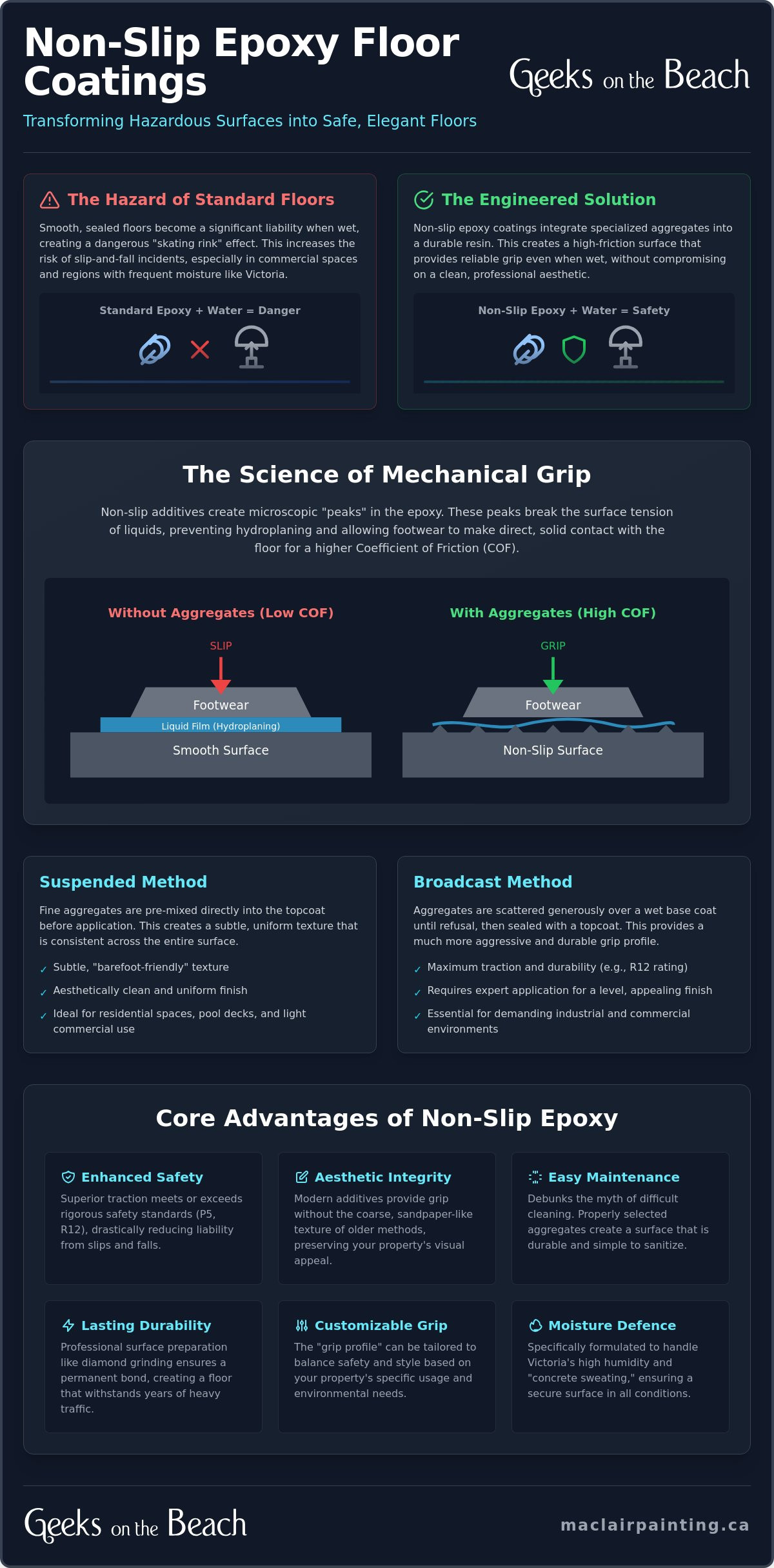
Traction on a coated surface is governed by the Coefficient of Friction (COF), a mathematical ratio that measures the relationship between the force of friction and the weight of the object moving across the surface. For non-slip epoxy floor coatings, we focus on increasing this ratio to ensure stability under foot. While local BC building codes provide the framework for safety, international benchmarks like the Cal/OSHA floor safety regulations illustrate the rigorous standards required to maintain secure footing in high-risk environments. A higher COF means more resistance, which is vital when surfaces become wet or contaminated.
The physical mechanism behind this safety is known as mechanical grip. By introducing specialized aggregates into the liquid resin, we create microscopic “peaks” that protrude through the surface film. These peaks serve a critical function: they break the surface tension of liquids. Instead of hydroplaning on a thin layer of water or oil, footwear makes direct contact with these solid points. This ensures that even in the middle of a Victoria rainstorm, an entryway remains a predictable, high-traction environment rather than a hazard.
Integrating these media typically involves two distinct techniques: the suspended method and the broadcast method. In the suspended method, fine additives are mixed directly into the topcoat before application, resulting in a subtle, uniform texture. The broadcast method is more intensive; it involves scattering aggregates over a wet base coat until the surface is saturated. This second approach provides a much more aggressive grip, though it requires a master craftsman’s touch to ensure the finish remains level and visually appealing. If you are unsure which method suits your facility, our specialists can help you evaluate your specific surface needs to find the perfect balance.
Types of Anti-Slip Aggregates
- Quartz and Silica Sand: These are the industry standard for industrial settings. They provide a rugged, crystalline structure that stands up to heavy machinery and constant foot traffic.
- Polymer and Glass Beads: These rounded media are preferred for residential interiors. They offer a “barefoot-friendly” texture that provides safety without feeling abrasive on skin.
- Aluminum Oxide: Known as the “heavy hitter” of aggregates, this material is extremely hard and wear-resistant. It is the ideal choice for high-traffic parkades and warehouses where durability is the primary concern.
In large-scale industrial environments, safety is often a multi-layered strategy. Beyond the physical traction provided by the coating, you can explore Warehouse Floor Striping to see how StripeGuys Warehouse Line Striping utilizes clear visual markers to organize traffic and enhance overall facility security.
For property managers looking for further examples of professional industrial flooring applications, you can check out Polished Concrete Atlanta to see how high-performance systems are implemented in large-scale commercial settings.
Texture Levels and Their Applications
- Level 1 (Fine): A subtle texture that is nearly invisible to the eye. It is perfect for residential basements or office spaces where aesthetics are paramount.
- Level 2 (Medium): This is the versatile standard for commercial kitchens, locker rooms, and medical clinics. It balances high traction with a surface that remains relatively easy to mop.
- Level 3 (Coarse): An aggressive, highly visible grip designed for the most demanding areas. We recommend this for ramps, loading docks, and external walkways exposed to the elements.
Strategic Applications: Where Non-Slip is Essential
Identifying where traction is most critical is the first step toward a safer environment. In high-traffic commercial zones like retail stores and hospitality venues, the risk of a slip is not just a safety concern; it is a significant liability. International standards, such as OSHA’s general requirements for floor safety, emphasize the necessity of maintaining walking surfaces in a hazard-free condition. For property managers overseeing strata complexes and multi-unit buildings, non-slip epoxy floor coatings are an essential investment for common areas, stairwells, and parkades where moisture is frequently tracked in from the outside. These spaces require a durable finish that stands up to constant use while providing a reliable grip for residents and visitors alike. Property managers responsible for vehicle areas will find that our guide to parkade flooring for Victoria’s commercial assets addresses the specific structural and safety challenges these environments present.
The strategic use of texture allows property owners to address specific vulnerabilities without over-engineering every square foot. While a loading dock might require an aggressive broadcast of aluminum oxide, a lobby can achieve safety through more subtle, suspended polymer beads. This tailored approach ensures that your flooring remains functional and sophisticated. For a broader look at how these systems integrate into comprehensive property care, our guide on epoxy floor coating Victoria BC provides the necessary context for property owners on Vancouver Island.
Medical and Healthcare Facilities
Medical and healthcare facilities face a unique challenge. They must adhere to strict hygiene standards while ensuring the safety of staff and patients who may be moving quickly in high-pressure situations. We specialize in providing seamless, non-porous surfaces that don’t trap bacteria in the texture, which is a common concern with lower-quality applications. The goal is to provide enough traction to prevent falls without creating deep crevices that hinder sanitation. You can find more details on these specific healthcare requirements in our guide to epoxy flooring for medical facilities Victoria.
The Modern Residential Garage and Basement
In the residential sector, the transformation of a damp Victoria basement or a slick garage floor into a secure living space is a hallmark of our craftsmanship. A basement that feels cold or damp can be revitalized into a sophisticated area for the family to enjoy. Similarly, a garage floor exposed to wet tires and Vancouver Island’s humidity requires a robust texture to prevent accidents. These upgrades are covered extensively in our discussion on epoxy basement flooring Victoria. By choosing the right texture for the right environment, you ensure long-term protection and the preservation of your property’s value.
Maintenance and Longevity of Textured Coatings
A common hesitation among property owners is the fear that non-slip epoxy floor coatings will inevitably become “dirt magnets.” This is a misconception that often stems from poorly executed DIY projects or the use of low-quality materials. A professionally engineered coating encapsulates the aggregates within the resin matrix, providing essential grip without creating deep, unreachable pockets for grime. The longevity of this traction depends entirely on the precision of the initial application. A master craftsman ensures the media is evenly distributed and properly bonded, preventing the premature “shedding” of aggregates that often occurs with inferior systems.
In the unique climate of Vancouver Island, UV resistance plays a critical role in the durability of your floor’s texture. Constant exposure to sunlight through garage windows or commercial storefronts can cause standard resins to become brittle. We utilize UV-stable topcoats to ensure the colour remains vibrant and the resin maintains its flexibility. This protection ensures the texture doesn’t flake away under the stress of thermal expansion and contraction, which is common during Victoria’s seasonal shifts. Protecting this investment requires a proactive approach to care. Homeowners who have already explored concrete floor epoxy Victoria options will recognize that UV-stable, moisture-resistant formulations are the benchmark for lasting performance in our coastal environment.
Best Practices for Cleaning Textured Epoxy
Maintaining a textured surface requires a slightly different methodology than a smooth floor. While a standard mop is sufficient for fine textures, coarser profiles often benefit from the use of a soft-bristle brush. Agitation is necessary to lift debris from around the aggregate peaks. We recommend using pH-neutral cleaners that don’t leave a slippery film or degrade the resin over time. It’s also wise to follow the “rinse and dry” rule. Victoria’s water supply contains minerals that can leave a cloudy buildup if allowed to air-dry on a textured surface, eventually dulling the finish and potentially reducing the effective traction of the floor.
Signs Your Surface Needs Professional Attention
Over time, even the most resilient coatings will show signs of wear in high-traffic medical centres or retail corridors. You can perform a simple “Smooth Spot” test by checking entryways or pivot points for a loss of tactile grip. If the non-slip epoxy floor coatings feel noticeably smoother than the surrounding floor, it is time to intervene before the area becomes a safety hazard. Occasionally, texture loss is accompanied by delamination, which often signals an underlying moisture issue within the concrete slab that requires expert diagnosis. Re-coating is a cost-effective alternative to a full floor replacement for aged floors that have lost their original traction profile.
If your current surface has lost its grip or you’re ready to upgrade to a professionally installed safety solution, contact our team for an expert evaluation of your property’s needs.
The MACLAIR Standard: Precision Application in Victoria
Achieving a flawless finish requires more than high-quality resins; it demands an uncompromising commitment to surface preparation. At MACLAIR, we consider professional diamond grinding to be the non-negotiable foundation of every project. While some might suggest simpler methods, grinding mechanically opens the concrete’s pores to create a specific profile. This allows the resin to penetrate deeply, ensuring a bond that withstands heavy vehicular traffic and the relentless humidity of Vancouver Island. Without this meticulous preparation, even the most advanced non-slip epoxy floor coatings risk premature failure or delamination.
Every property has unique requirements, which is why we specialize in customizing the “Grip Profile” for each client. We don’t believe in a one-size-fits-all texture. Instead, we match the density and type of aggregate to your specific usage, whether you’re managing a high-traffic strata parkade or a quiet residential basement. This precision ensures that your floor meets local Victoria safety standards and strata bylaws without sacrificing the sophisticated aesthetic of your space. We prioritize indoor air quality by utilizing low-VOC, high-performance materials that are safe for both our craftsmen and your family or staff.
Our Meticulous Coating Process
Success is found in the details of our structured narrative. We begin with rigorous moisture testing to ensure the concrete substrate is ready for a long-term bond, addressing the capillary action common in coastal BC homes. To achieve a uniform, high-density finish, we often employ a “Double-Broadcast” technique. This process involves multiple layers of aggregate to ensure there are no “bald spots” in the traction profile. Our final inspection is a thorough verification of texture consistency across the entire surface, ensuring that every square foot provides the reliable grip you expect from a premium installation.
Partnering with Victoria’s Coating Experts
Our localized experience with the specific weather patterns of British Columbia informs every material selection we make. We understand how the damp winters and shifting temperatures of the Pacific Northwest affect the curing and performance of resinous floors. Choosing a master craftsman means benefiting from an eye for detail that looks beyond the immediate finish toward the long-term preservation of your property’s value. It is this blend of technical authority and a personalized, customer-centric approach that defines our work. If you are ready to transform your environment, consult with MACLAIR for your non-slip epoxy project and experience the difference that precision makes.
Elevating Safety and Sophistication for Your Victoria Property
Investing in non-slip epoxy floor coatings is a decision to prioritize the long-term integrity and safety of your environment. We have explored how the precise integration of specialized aggregates transforms hazardous surfaces into high-traction zones without sacrificing aesthetic elegance. The true strength of a coating lies in the meticulous diamond grinding of the substrate and the master craftsman’s ability to tailor texture levels to specific usage needs. Whether you’re managing a complex strata property or a specialized medical facility, the balance between durability and cleanability is achievable with the right professional expertise.
As trusted Victoria-owned master craftsmen, we take immense pride in delivering premium, high-durability finishes that stand up to our unique coastal climate. We invite you to Request a Professional Coating Consultation with MACLAIR to discuss how we can enhance your property’s value and security. It’s time to create a space that is as safe as it is beautiful, providing you with absolute peace of mind through every season.
Frequently Asked Questions
Is non-slip epoxy floor coating hard to clean?
No, a professionally installed textured floor is not inherently difficult to maintain if the correct aggregate is selected. Unlike crude DIY methods that trap grime in deep pits, our precision-engineered beads allow a mop or soft-bristle brush to glide effectively over the surface. Regular maintenance with a pH-neutral cleaner ensures that debris is lifted from around the traction peaks, keeping the floor hygienic and visually polished.
Can I add non-slip texture to an existing epoxy floor?
Yes, it’s possible to integrate a new texture into an existing surface provided the original coating is still well-bonded to the concrete. We typically perform a light mechanical screening to create a profile on the old resin before applying a fresh topcoat infused with traction media. This approach is a cost-effective way to upgrade the safety of your space without the need for a full floor replacement.
Is the texture of non-slip epoxy too rough for bare feet?
The texture is entirely customizable and does not have to be abrasive or uncomfortable. For residential interiors like basements or pool decks, we utilize rounded polymer beads that provide a “barefoot-friendly” grip. These spherical additives offer reliable traction without the sharp, jagged edges found in industrial-grade quartz or aluminum oxide, ensuring comfort for every member of your family.
How long does a non-slip epoxy coating typically last in a garage?
A professionally applied non-slip epoxy floor coatings system can last between 10 and 20 years in a residential garage environment. Longevity depends heavily on the quality of the initial diamond grinding and the use of UV-stable topcoats to prevent brittleness. Consistently removing road salt and abrasive grit will ensure the traction profile remains effective for the entire lifespan of the coating.
Does adding non-slip aggregate change the colour of the floor?
Adding traction media generally does not alter the base colour of your floor. Most modern aggregates, such as clear glass beads or micronized polymers, are translucent and designed to disappear into the resin matrix. In full broadcast flake or quartz systems, the aggregate itself defines the final aesthetic, resulting in a vibrant, multi-toned finish that is both functional and artistically sophisticated.
Can non-slip epoxy be used on outdoor concrete steps in Victoria?
Yes, non-slip epoxy is an excellent solution for outdoor steps, provided the system is specifically formulated for UV resistance and moisture tolerance. In Victoria’s damp climate, we recommend a coarser texture for external stairs to ensure secure footing during heavy rainfall. This application prevents the concrete from becoming a hazard when exposed to the frequent moisture typical of Vancouver Island.
What happens if the non-slip texture wears down over time?
If high-traffic areas begin to feel smooth, the floor can usually be refreshed with a targeted re-coating process. This involves cleaning and lightly abrading the existing surface before applying a fresh layer of resin and traction media. It is a proactive maintenance step that restores the original safety rating and aesthetic clarity without requiring a total overhaul of the flooring system.
Is non-slip epoxy required by law for commercial businesses in BC?
While provincial regulations don’t mandate epoxy specifically, the BC Building Code and WorkSafeBC require commercial walking surfaces to be maintained in a safe, slip-resistant condition. For high-risk environments like commercial kitchens or medical clinics, non-slip epoxy floor coatings are a preferred industry standard. They provide a verifiable way for business owners to meet their legal safety obligations and reduce liability.