
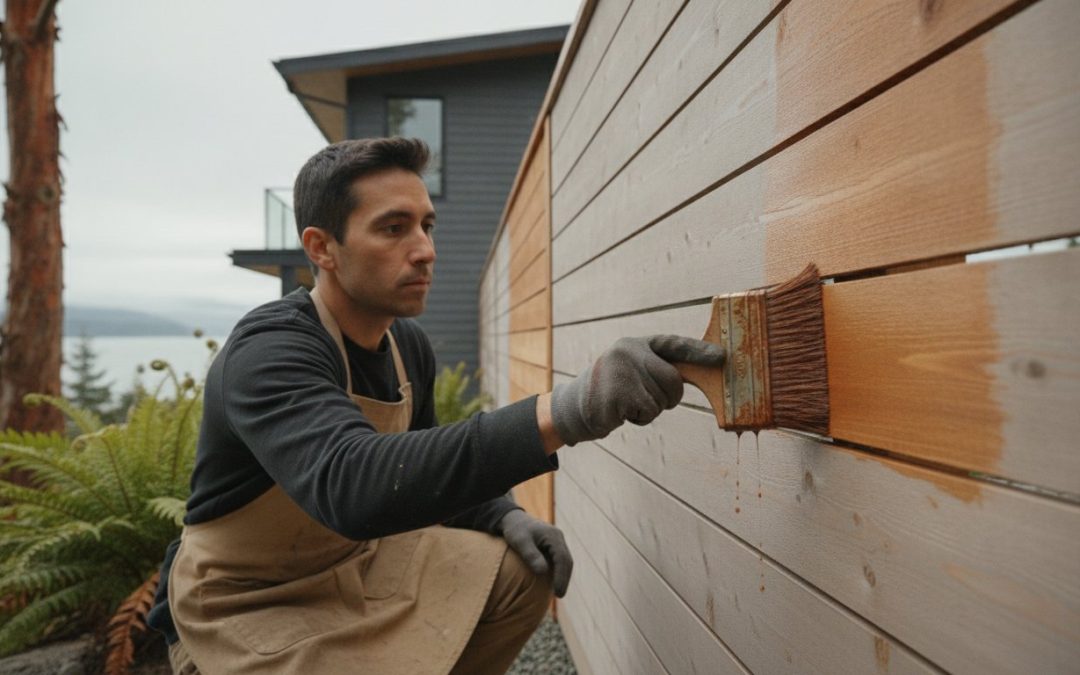
Why do some Saanich fences remain rich and vibrant for a decade while others turn a ghostly, brittle grey in just two seasons? It is a common frustration for property owners who value curb appeal but find themselves fighting an uphill battle against the unrelenting moisture and salt air of Vancouver Island. You likely realize that the coastal environment is unforgiving, and the fear of a fresh stain peeling or flaking away after one wet winter is a valid concern that often leads to maintenance paralysis. Finding the right approach to wood fence staining Victoria BC requires more than a quick brush and a bucket of hardware store paint; it demands a professional strategy rooted in preservation and precision.
This guide reveals the secrets to achieving a finish that does not just look exquisite but actually fortifies your timber against rot and UV damage. You will discover how to navigate the confusion between oil and water-based coatings to find the perfect match for our high-humidity climate. We provide a clear, methodical timeline for the staining process, ensuring your investment results in a vibrant, deep colour that stands the test of time and enhances your property’s value for years to come.
Key Takeaways
- Understand how the unique humidity and salt air of Saanich accelerate wood silvering and how to build a multi-layered defence system against these coastal elements.
- Master the professional-grade cleaning and pH balancing techniques that ensure your stain bonds deeply with the wood for a finish that will not peel.
- Learn how to select the ideal pigment load for wood fence staining Victoria BC to balance natural aesthetics with superior UV protection.
- Discover the “Victoria Window” of perfect weather conditions and why the back-brushing technique is the gold standard for a seamless, professional result.
- Acquire a long-term maintenance schedule and learn the “water bead test” to accurately determine exactly when your fence requires its next protective coat.
The Art of Wood Preservation in Saanich’s Coastal Climate
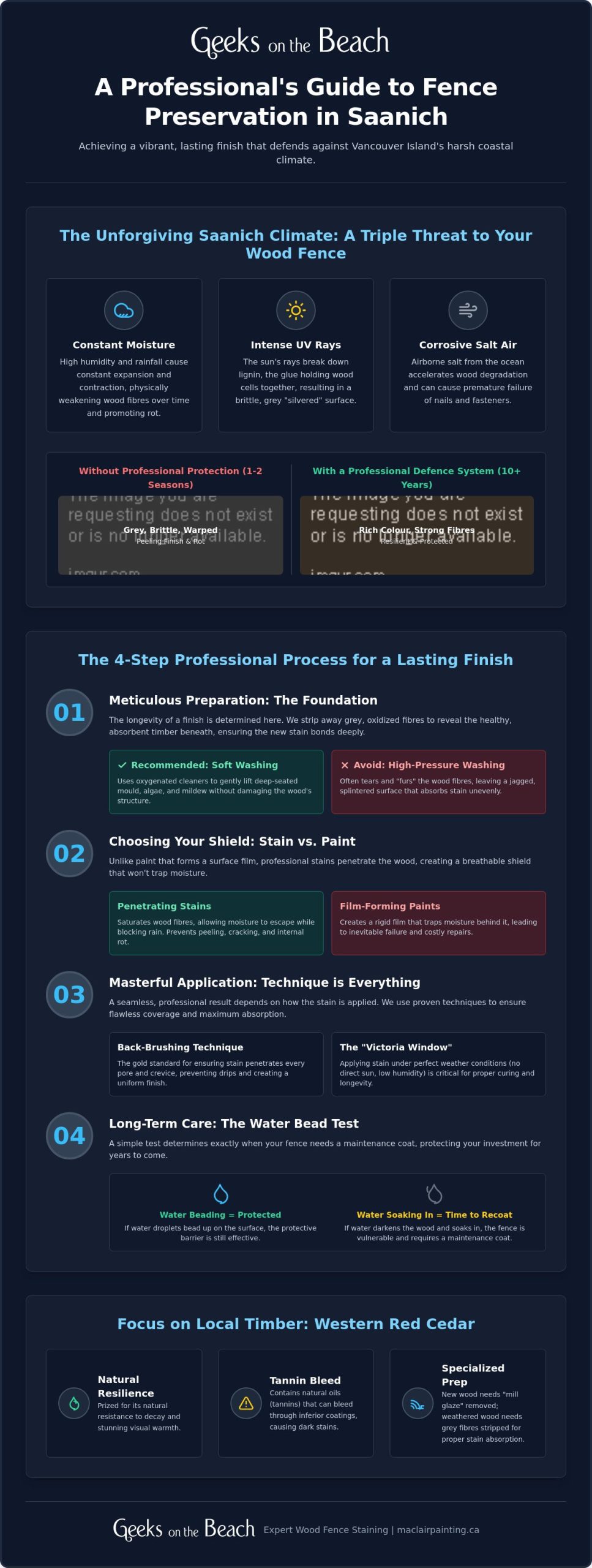
Wood staining is far more than a simple aesthetic choice; it is a sophisticated, multi-layered defence system engineered to shield your property from the elements. In the specific context of Saanich and the Greater Victoria area, where the air is heavy with moisture and salt, staining serves as the primary barrier against biological decay and structural degradation. Unlike traditional painting, which creates a rigid film on the surface, professional wood fence staining Victoria BC utilizes penetrating formulas that saturate the wood fibres. This distinction is vital because film-forming coatings often trap moisture behind the surface, which inevitably leads to peeling, cracking, and internal rot. By opting for a high-quality stain, you are choosing to preserve the structural integrity of the timber while simultaneously highlighting the organic beauty of its grain.
The ultimate objective of any preservation project is to extend the lifespan of the installation. Effective wood preservation techniques involve a deep understanding of how specific coatings interact with the cellular structure of the wood. When executed correctly, a professional stain provides a breathable yet hydrophobic shield that allows internal moisture to escape while preventing external rain from soaking into the boards. This balance is what separates a standard DIY effort from a result that remains resilient against our coastal environment.
Why Victoria Weather Demands a Specialized Approach
Our local microclimate presents a unique set of challenges that can quickly compromise untreated wood. High annual rainfall on Vancouver Island causes constant cycles of expansion and contraction in wood fibres, a process that physically weakens the timber over time. Simultaneously, the intense UV exposure common in our coastal summers triggers “silvering,” a form of photodegradation where the sun’s rays break down the lignin that holds wood cells together. Without a pigment-rich stain to block these rays, the wood becomes brittle and grey. When moisture is allowed to sit on these compromised surfaces, it creates the perfect environment for fungi to thrive, leading to premature rot that can ruin a fence in just a few short years. The same coastal forces that threaten fences also affect other outdoor timber structures, and property owners who want to understand how these principles apply to their entire exterior should review our professional deck staining selection guide for Victoria property owners.
Local Wood Species: Understanding Western Red Cedar
Western Red Cedar is the hallmark of fencing in Saanich, prized for its natural resistance to decay and its stunning visual warmth. However, this species contains high levels of natural tannins, which are organic chemicals that can sometimes bleed through inferior coatings and cause unsightly dark staining. Professional wood fence staining Victoria BC requires an expert understanding of these tannins to ensure the chosen product bonds effectively. It is also important to recognize that “new wood” often possesses a mill glaze from the sawing process that prevents stain absorption, whereas weathered wood has open pores but requires the removal of dead, grey fibres to reveal the healthy timber beneath. Each state requires a tailored preparation strategy to ensure the preservation effort is successful.
Meticulous Preparation: The Secret to a Long-Lasting Finish
The longevity of a finish is decided long before the first drop of stain touches the wood. In fact, the preparation phase represents the vast majority of the total labour in a professional project. When executing wood fence staining Victoria BC, the primary objective is to remove the oxidized, grey wood fibres that have been damaged by UV exposure. These dead fibres no longer have structural integrity; if they aren’t removed, your new coating will simply sit on top of a failing surface and peel away within months. A truly professional approach involves stripping back the years to reveal the healthy, absorbent timber beneath.
The Cleaning Phase: Soft Washing vs. Pressure Washing
It’s a common misconception that higher pressure equals a cleaner fence. In reality, high-pressure washing often does more harm than good by “furring” the wood, a process where the water pressure tears the wood fibres and leaves a jagged, splintered texture. We advocate for a soft washing technique using oxygenated cleaners. This method gently lifts deep-seated decontamination, such as the moss, algae, and mildew that thrive in our damp coastal environment, without compromising the wood’s physical structure. It ensures a deep clean while maintaining the smooth, refined surface required for an elegant finish.
Once the organic growth is removed, the wood must be neutralized. Cleaning agents are often alkaline, which can darken the wood and interfere with stain bonding. Applying a wood brightener restores the proper pH balance and re-opens the wood’s pores. This meticulous attention to surface chemistry is supported by the USDA guide to protecting wood fences, which highlights that a neutralized, chemically receptive surface is essential for the long-term success of any preservative treatment.
Sanding for Success: Achieving the Ideal Surface
Mechanical sanding is the final, essential step in our preparation masterclass. We typically employ a light sand using 60 to 80 grit paper to create a uniform profile. For new fences, this is the only way to effectively combat mill glaze. Mill glaze is a shiny, compressed surface caused by high-speed planers in the mill. This glaze acts as a mechanical shield that prevents stain from penetrating the wood cells. By sanding, we break this seal and ensure the wood fence staining Victoria BC project achieves maximum saturation. If you are looking for a result that reflects true craftsmanship, investing in professional wood staining services ensures every one of these technical hurdles is handled with precision.
Before any product application begins, the substrate must be thoroughly dry. We utilize professional moisture meters to confirm that the internal moisture content has dropped to an optimal level for absorption. Applying stain to a damp fence traps water inside, which can lead to internal rot and a cloudy, blotchy appearance that ruins the aesthetic of your property.
Choosing Your Aesthetic: Stains, Sealers, and Protective Finishes
Selecting the right finish for wood fence staining Victoria BC is a delicate negotiation between your architectural vision and the biological requirements of the timber. Every homeowner desires a fence that complements their landscape, but it’s vital to recognize that your aesthetic choice directly dictates the maintenance schedule for years to come. The primary factor in this equation is pigment load. Pigments act as microscopic shields, absorbing and reflecting the sun’s destructive ultraviolet rays before they can reach the wood fibres. As noted in this academic review of outdoor wood finishes, there is a direct correlation between the opacity of a coating and its ability to resist moisture and UV degradation.
Opacity and Longevity: Finding the Right Balance
Your choice of opacity determines how much of the natural wood character remains visible and how frequently you will need to re-apply the coating. We generally categorize these options into three distinct tiers:
- Transparent Stains: These provide a clear or slightly tinted film that allows the full beauty of the wood grain to shine through. While visually stunning, they offer the least UV protection and typically require annual or biennial attention in our coastal sun.
- Semi-Transparent Stains: Often regarded as the “Victoria Standard,” these products contain enough pigment to provide significant UV resistance while still allowing the texture and grain of the wood to remain visible. They offer an ideal middle ground for those seeking durability without sacrificing the organic look of Western Red Cedar.
- Solid Stains: These provide a rich, opaque colour that behaves much like paint but remains breathable. They offer the highest level of protection and can last five years or more, making them excellent for older fences where masking imperfections is a priority.
Oil-Based vs. Water-Based Stains for Coastal BC
The debate between oil and water-based formulas often comes down to the condition of the wood and the desired finish. Traditional oil-based stains are celebrated for their deep penetration and conditioning properties; they replenish the natural oils in the wood and are incredibly easy to maintain because they don’t peel. However, modern water-based alkyd hybrids have become increasingly popular for wood fence staining Victoria BC due to their superior colour retention and resistance to mildew, which is a constant threat in our damp climate. For a sophisticated West Coast look, we often recommend “toning,” a process using specialized transparent tints that enhance the natural warmth of cedar without the heavy look of a full stain. This technique provides a subtle, sun-kissed glow that feels both premium and timeless. Property owners who want to apply these same product selection principles to their outdoor decking can find detailed guidance in our Victoria deck staining guide covering high-performance stain selection for coastal conditions.
The Application Masterclass: Techniques for a Seamless Result
Precision in application is what separates a mediocre result from a masterpiece. While the preparation steps discussed previously establish the foundation, the actual delivery of the coating requires a high level of technical finesse to ensure longevity and visual uniformity. For high-end wood fence staining Victoria BC, the gold standard is a technique known as back-brushing. This involves applying the stain, often via a professional sprayer for even coverage, and immediately following with a brush to force the product deep into the wood fibres. This mechanical action breaks the surface tension and ensures the stain saturates the cellular structure of the timber rather than simply resting on the surface.
Mastering this phase also requires a keen eye for potential pitfalls like lap marks and “shiners.” Lap marks occur when a wet section of stain overlaps a section that has already begun to dry, creating a darker, double-pigmented line that ruins the continuity of the finish. Shiners, conversely, are shiny spots that appear when too much product is applied and the wood cannot absorb the excess, leaving a glossy film that eventually flakes. If you want to ensure your property receives this level of technical care, you can book our wood staining services to secure a durable, premium finish.
The Professional’s Toolkit: Application Methods
Efficiency and thoroughness are best achieved by combining modern technology with traditional craftsmanship. We utilize professional-grade sprayers to reach deep into the crevices between boards, followed immediately by back-brushing with high-quality natural bristle brushes for oil-based products. This combination ensures every square inch of the fence is protected. When handling vertical surfaces, we work from the top down to manage drips, while horizontal elements like top rails require careful monitoring to prevent pooling. This methodical approach ensures a rich, even distribution of pigment across the entire structure.
Timing the Victoria Window: Weather and Environment
The unpredictable nature of coastal weather means that timing is everything. We look for the “Victoria Window,” which consists of temperatures between 10°C and 25°C with no rain forecast for at least 48 hours. Staining in the direct, hot Saanich sun can be disastrous, as it causes the product to “flash dry” before it can properly penetrate the grain, leading to a blotchy and unstable finish. Before any application begins, we use a professional moisture meter to verify the substrate’s readiness. Wood moisture content must be below 18% before staining can begin. This data-driven approach guarantees that the wood is thirsty enough to pull the protective oils deep inside, creating a bond that will withstand the coming winters.
Long-Term Care and the MACLAIR Standard of Excellence
Preservation is a continuous journey rather than a single event. Even the most meticulously applied wood fence staining Victoria BC project eventually faces the erosive forces of wind, rain, and UV radiation. To ensure your investment remains secure, we recommend performing a simple “water bead test” every spring. Simply splash a small amount of water onto several areas of the fence; if the water beads up and rolls off, the hydrophobic seal is still active. If the water soaks into the timber and darkens the grain, the protective resins have likely eroded, and a maintenance coat is required to prevent moisture from reaching the core of the wood fibres.
Establishing a predictable maintenance schedule is the most effective way to avoid the high costs of total wood restoration. A gentle cleaning every twelve to eighteen months removes surface dust and organic spores before they can take root in the wood’s pores. This proactive approach does more than keep the fence looking vibrant; it preserves the structural integrity of the timber, preventing the warping and splitting that often lead to expensive structural replacements. By treating your fence as a living component of your landscape, you maintain both its beauty and its value.
Beyond timber fencing, many homeowners incorporate other durable materials to enhance their outdoor living spaces. For instance, if you are considering modern glass or metal features for your property, you can learn more about Vision Balustrading and their premium balustrade and pool fencing options.
The Annual Inspection: What to Look For
During your yearly walk-around, pay close attention to the South and West-facing sections of your fence. These areas receive the most intense UV exposure and typically show signs of fading or “greying” well before the shaded sections. You should also inspect the bottom of the fence panels where they meet the ground or vegetation, as this is where moisture ingress is most common due to splashback and limited airflow. It is vital to distinguish between simple surface dirt, which can be rinsed away with a garden hose, and actual finish failure, such as cracking or thinning of the stain, which indicates the wood is no longer shielded.
Why Professional Craftsmanship Matters
Choosing a partner like MACLAIR Painting ensures your property benefits from specialized equipment and technical expertise that DIY methods cannot replicate. Our methodical approach to wood fence staining Victoria BC can effectively double the lifespan of the finish by ensuring perfect adhesion and saturation during the initial application. We invite you to explore our deeper philosophy on Premium Wood Staining Services Victoria: Preserving Coastal Craftsmanship to understand how we elevate property care to an art form.
When you are ready to secure the longevity of your exterior timber with a result that reflects true pride in craftsmanship, Contact MACLAIR Painting for a professional wood staining consultation and experience the peace of mind that comes with an essential investment in your home’s environment.
Secure the Longevity of Your Coastal Property
Transforming a weathered fence into a vibrant property asset requires more than just a fresh coat of colour. It demands a sophisticated understanding of wood science and the specific environmental pressures unique to Vancouver Island. By prioritizing meticulous surface preparation and selecting professional-grade, UV-resistant finishes, you move beyond mere maintenance toward true property preservation. You now recognize that technical precision, such as back-brushing and moisture monitoring, forms the essential foundation of a result that survives our damp winters and intense coastal sun.
MACLAIR Painting brings specialized expertise in Saanich and coastal BC wood preservation to every project, ensuring your timber receives the methodical care it deserves. We take pride in a craftsmanship-first approach that guarantees maximum longevity and aesthetic excellence. When you are ready to invest in a transformative experience for your home’s exterior, Request a Professional Wood Staining Quote from MACLAIR Painting to begin your restoration. Our team is dedicated to wood fence staining Victoria BC with a level of detail that protects your investment. Let’s ensure your fence remains a beautiful, resilient feature of your landscape for years to come.
Frequently Asked Questions
How long does a wood fence stain usually last in the Victoria climate?
A professional stain typically lasts between three and five years, though the specific lifespan depends heavily on the product’s opacity and the fence’s sun exposure. Transparent stains may require maintenance every one to two years, while solid stains offer the longest protection. Because our coastal environment involves high humidity and salt air, regular inspections are vital to ensure the protective seal remains intact before the wood begins to grey.
Is it better to brush, roll, or spray stain on a fence?
The most effective method is a combination of spraying for efficient coverage followed immediately by back-brushing. While spraying reaches deep into the crevices between boards, the mechanical action of the brush is what forces the pigment into the wood fibres. This technique is a hallmark of high-quality wood fence staining Victoria BC, as it ensures maximum saturation and prevents the product from simply resting on the surface.
Can I stain my fence if it rained yesterday?
No, you must wait until the wood’s internal moisture content has dropped below 18% to ensure proper absorption. Even if the surface appears dry, the internal cells of the timber can remain saturated for several days after a rainfall. Applying stain to damp wood traps moisture inside, which inevitably leads to internal rot, a blotchy finish, and a coating that will likely peel away within a single season.
What is the best temperature for wood fence staining in BC?
The ideal temperature for application falls between 10°C and 25°C with moderate humidity levels. It’s best to avoid staining in the direct, midday sun, as excessive heat causes the product to dry too quickly on the surface. This prevents the protective oils from penetrating the grain, often resulting in “lap marks” and a finish that lacks the depth and durability required for our varied Vancouver Island weather.
Should I use oil-based or water-based stain for my cedar fence?
Oil-based stains are traditionally favoured for Western Red Cedar because they penetrate deeply to replenish natural oils and are easy to maintain without stripping. However, modern water-based alkyd hybrids are increasingly popular for wood fence staining Victoria BC due to their superior colour retention and mildew resistance. The choice often depends on the age of the fence and whether you prefer the ease of recoating or maximum UV protection.
Do I need to sand my fence before staining it?
Yes, sanding with 60 to 80 grit paper is an essential step to ensure the wood’s pores are open and receptive. For new lumber, sanding removes the “mill glaze” that blocks penetration; for weathered wood, it removes dead, grey fibres that prevent the stain from bonding. Skipping this step often results in an uneven finish and significantly reduces the overall lifespan of the protective coating.
What happens if it rains shortly after the stain is applied?
Rain within the first 24 to 48 hours can disrupt the curing process, often causing unsightly spotting or washing the pigment away entirely. If the stain has not had sufficient time to bond with the fibres, moisture can get underneath the finish and cause it to fail prematurely. If your project is caught in a sudden downpour, it typically requires a professional assessment to determine if a light sand and recoat are necessary.